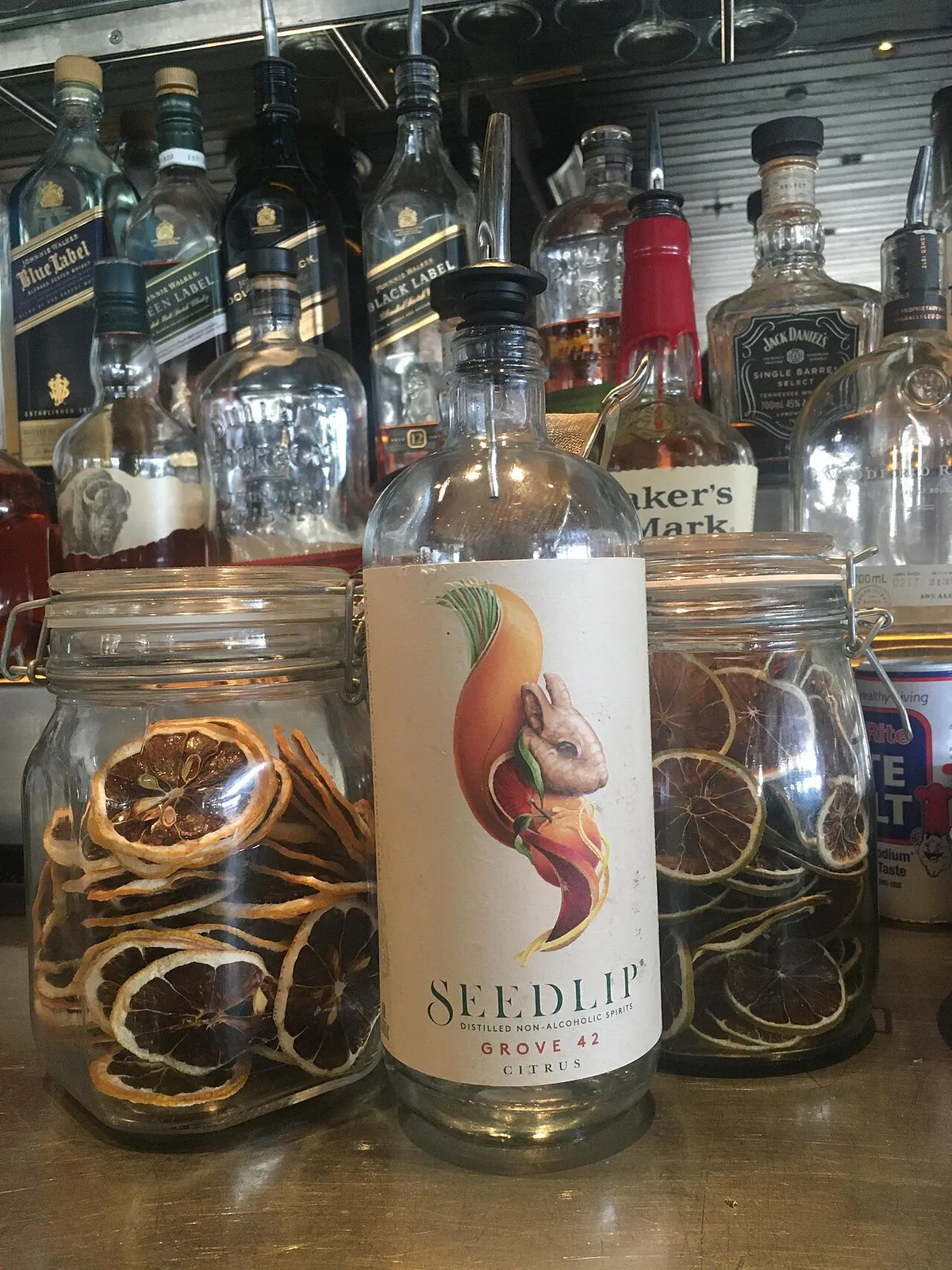
Walk into any decent liquor store this year and look at the non-alcoholic shelf. A 750 ml of Ritual Zero Proof gin alternative runs about $25. Lyre’s Dry London is around $35. Seedlip hovers near $34. A bottom-shelf vodka? Twelve bucks. A fine mid-shelf tequila that will absolutely wreck you? Twenty-two. The thing with no alcohol in it costs more than the thing that will put you on the floor.
We have been pouring drinks since 2008, and we get this question in our inbox more than almost any other NA question: why are NA spirits expensive? The short answer is that the alcohol is not what you were paying for in the first place. The longer answer, which actually matters when you are deciding whether to drop $30 on a bottle of booze free gin, is the rest of this article.
Isn’t the alcohol tax most of a vodka bottle’s price?
This is the first guess almost everyone makes, and it is almost entirely wrong.
Federal excise tax on a standard 80 proof spirit works out to about $2.14 per 750 ml bottle in 2026. State taxes add a bit more depending on where you live, but in a $12 handle of vodka, taxes are a small share of the shelf price. The majority of a cheap vodka’s price is bottle, cap, label, shipping, retailer margin, and a thin production cost on top of water and neutral grain spirit that is made in enormous volumes.
So when a founder of a legit NA brand tells you excise tax is not the reason their bottle costs $30, believe them. Mehmet Unlu of Undone put it plainly to Food Dive earlier this year: “The cost of quality ingredients, production, packaging, and flavor development is very real, excise tax aside, non-alc doesn’t necessarily mean cheap to make.”
How a non-alcoholic spirit actually gets made
There are three main ways to make a convincing NA spirit, and all of them are more expensive than making vodka.
Method 1: distill, then strip the alcohol. This is what Seedlip and most higher-end brands do. You start by actually distilling botanicals in a traditional pot still, which means you have made real gin or real whiskey. Then you pass that liquid through reverse osmosis or vacuum distillation to pull the ethanol back out. The flavor compounds stay, the alcohol leaves, and you throw away gallons of ethanol you already paid tax on. That is twice the process and roughly twice the labor of a regular gin.
Method 2: cold maceration and extraction. Soak botanicals in water or glycerin at low temperature, pull out the essential oils and flavor compounds, filter, blend, bottle. No distillation step, but you need way more botanicals per bottle because water pulls out flavor less efficiently than alcohol does. Juniper, cardamom, saffron, allspice, these are not cheap ingredients when you need triple the quantity.
Method 3: build from natural flavor compounds and essences. Lyre’s uses this approach, blending essences to mimic specific spirits. It is more consistent batch to batch but relies on sourcing or developing high-quality natural flavor isolates, which is its own supply chain cost.
Every one of those methods costs more per bottle than running a neutral spirit column still at scale. There is no shortcut version that lets you skip the botanical cost.
The economies of scale problem
Here is the ugly math. Smirnoff makes roughly 25 million cases of vodka a year. The entire global non-alcoholic spirits category sold about $325.8 million worth of product in 2023, and is forecast to grow to $706.7 million by 2033. That is the whole category, every brand combined, hitting roughly 1 percent of what one single vodka brand does in volume today.
When Smirnoff orders bottles, caps, and corrugate, they get prices nobody at Ritual or Lyre’s can touch. When their trucks leave the distillery, those trucks are full. Smaller NA brands pay more per bottle, more per label, more per pallet, more per mile. That cost sits on top of the already-higher production cost.
| Cost input | $12 vodka (per bottle) | $30 NA spirit (per bottle) |
|---|---|---|
| Base liquid production | Pennies | $3 to $6 |
| Botanicals and flavorings | None or minimal | $4 to $8 |
| Dealcoholization or extraction | N/A | $2 to $4 |
| Bottle, cap, label | $1.00 to $1.50 | $2.50 to $4.00 |
| Freight and warehousing | $0.50 | $1.50 to $2.50 |
| Federal and state excise tax | ~$2.14 to $3.50 | $0.00 |
| Marketing and brand build | Low per unit | High per unit |
| Retailer and distributor margin | 30 to 40% | 35 to 45% |
Those are rough industry ranges, not any one company’s P&L. The pattern is what matters. NA takes a hit on ingredients, process, packaging, and freight, and only gets back a small saving on excise tax. That is why the shelf prices land where they do.
Why packaging costs more too
NA spirits have a shelf life problem that vodka does not. Alcohol is a preservative. Pull it out of a liquid full of botanical extracts and natural sugars, and that liquid becomes a lot friendlier to spoilage. Brands fix this three ways and none of them are free.
They use UV blocking glass, which costs more than clear glass. They use nitrogen flushing on the fill line so there is no oxygen in the headspace, which requires specialized bottling equipment. And they often add small amounts of natural preservatives like citric acid, potassium sorbate, or in some cases pasteurization steps. Every one of those is a line item that neutral vodka skips.
Then there is the “once opened, refrigerate and use within X weeks” line on most NA labels. Vodka in your freezer lasts forever. An opened bottle of NA gin needs to be in the fridge, and once it is, you have a window. That reality shapes the whole package design. The bottle has to look premium enough to justify the price, but the liquid inside is more fragile than any real spirit.
The brand premium that is actually real
We are not going to lie to you. Part of what you pay for a $35 bottle of Lyre’s or Seedlip is marketing budget, celebrity founders, Instagram-first launch strategies, and premium store placement at Whole Foods. The category needed to build itself out of the “sad juice at the back of the bar” image, and that cost money.
But that is not purely wasteful. Convincing people that an NA cocktail at a nice restaurant is worth $12, which is where the margin for bars and restaurants comes from, took years of brand work. Without that premium positioning, the category would still be stuck at “weird non-alcoholic beer and the kids’ menu,” which was exactly where it was in 2015.
What this all means for your home bar
If you are building out a non-alcoholic home bar for the first time, three things to keep in mind.
First, you do not need to buy five NA spirits to start. One good NA gin alternative or NA whiskey alternative covers most cocktail territory. Pair it with good tonic, good citrus, and bitters that are mostly flavor-not-alcohol anyway, and you can make a lot of drinks.
Second, NA beer and hop water are a much better dollar-per-drink deal than NA spirits right now. A twelve pack of good NA beer like Athletic Run Wild is around $18, which lines up with normal craft prices. The economies of scale are already there because NA beer has been a category longer.
Third, if a bottle fails the taste test for you, do not blame the whole category. Different brands take wildly different approaches, and your palate may hate one and love another. Our best non-alcoholic spirits roundup has our picks with specific tasting notes so you can pick based on what you actually drink, not based on the shelf-tag price alone.
Will NA spirits ever get cheaper?
Short answer: slowly, yes. Longer answer: not as much as you want.
The things that make NA expensive, the dealcoholization equipment, the specialized bottling lines, the smaller-batch botanical sourcing, do get cheaper when volumes grow. The forecast from Allied Market Research has the category more than doubling by 2033, which should pull per-bottle costs down. Diageo, Pernod Ricard, and most of the big spirits houses now have their own NA lines, which means more infrastructure gets built and shared across more SKUs.
But there is a floor. The botanicals cost what they cost. The flavor development investment stays the same whether you sell 10,000 bottles or 10 million. The packaging has to protect a less stable liquid than vodka protects itself. We expect to see prices soften from $30 toward $20 for the mainstream brands over the next five years, and we would not expect NA spirits to ever be as cheap as cheap vodka, because they genuinely cost more to make.
Drink what you like, in moderation, and know what you are paying for. The $30 is not a scam. It is just a different cost structure than the one you are used to.
Quick answers
Why are non-alcoholic spirits so expensive? Because the production is harder, not easier. Making a convincing NA spirit means distilling or vacuum-distilling botanicals, then stripping the alcohol back out through reverse osmosis or vacuum distillation. That requires specialized equipment, more raw botanicals per bottle, smaller batches, and higher packaging and shelf-stability costs. Excise tax is not the reason.
Isn’t the alcohol tax what makes real spirits expensive? No. Federal excise tax on an 80 proof spirit is about $2.14 per 750 ml bottle. That is a small part of the retail price. When Ritual or Lyre’s sells for $25 to $35, you are paying for ingredients and process, not avoided tax.
Will NA spirits get cheaper over time? Probably, yes, but slowly. The market was $325.8 million in 2023 and is forecast to hit $706.7 million by 2033. As volumes rise, dealcoholization equipment gets amortized across more bottles and prices should ease. We would not hold our breath for $12 NA gin this year.
Is dealcoholized wine made the same way? The process is similar in spirit but different in detail. NA wine is usually real wine put through spinning cone columns or reverse osmosis to pull out the alcohol while keeping flavor. That extra step is why dealcoholized wine often costs as much as the regular bottle.
Which NA spirits give you the most for your money? Ritual Zero Proof around $25 is the honest value pick in the category. Lyre’s at $35 covers more styles. Seedlip Garden 108 is herbal, not a gin copy, and costs about $34. See our best non-alcoholic spirits roundup for the full list.
Drinking is a personal choice, and skipping it is just as valid. If you are cutting back, our mocktails list covers drinks that are good on their own merits.