The negroni recipe has three ingredients, equal parts, and about a hundred years of debate over what belongs in a rocks glass under an orange peel. We have been stirring these since 2008, and the only real difference between a great one and a forgettable one is respect for the ice, the peel, and the ratio. Get those right and the drink does the rest of the work.
What is the classic negroni recipe?
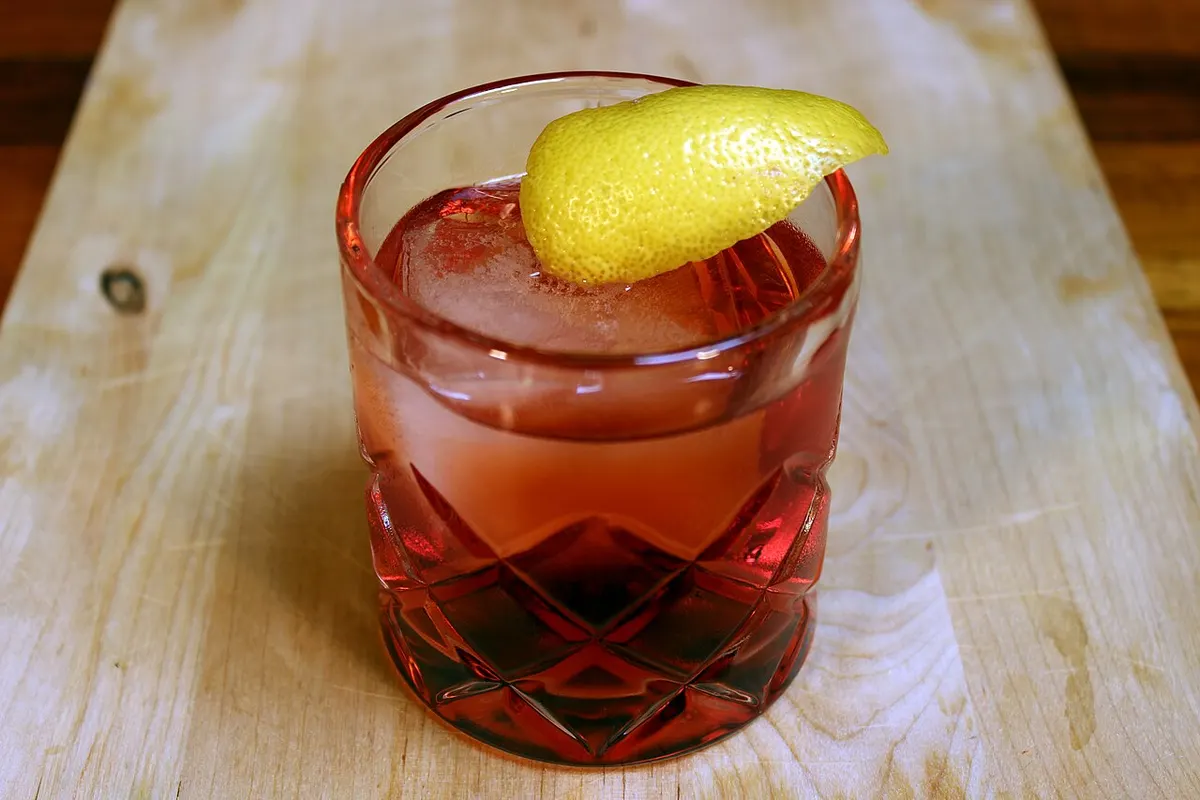
One ounce of gin, one ounce of Campari, one ounce of sweet vermouth. Stirred over ice for about 20 seconds, strained over one big cube in a rocks glass, garnished with a wide strip of expressed orange peel. That is the whole drink.
Here is the exact build we use behind the bar:
- Combine 1 oz London dry gin, 1 oz Campari, and 1 oz sweet red vermouth in a mixing glass with plenty of cracked or cubed ice.
- Stir gently with a bar spoon for about 20 to 25 seconds until the outside of the glass frosts.
- Strain into a rocks glass over one large ice cube.
- Cut a wide strip of orange peel. Hold it skin-side down over the glass and pinch hard to express the oils on the surface.
- Rub the peel around the rim, then drop it in.
The IBA lists the negroni as an official contemporary classic and traces the drink to Florence in 1919, when Count Camillo Negroni asked a bartender at Caffè Casoni to reinforce his Americano by swapping the soda for gin. Every riff on the drink you will find, and there are dozens, works backward from that same equal-parts spine.
Why equal parts, and when to break the rule
The 1:1:1 ratio exists because it works. Gin brings juniper and structure, Campari brings bitterness and color, sweet vermouth brings body and a rounded sweetness that keeps the drink from turning into cough syrup. In equal parts, none of them wins.
That said, the ratio is a starting point, not a law. If you find the classic build too bitter, nudge the gin up to 1.25 or 1.5 oz and drop the Campari to 0.75 oz. If you want more of the wine-forward, herbal side of the drink, hold the gin at 1 oz and go 1.25 oz vermouth. What we do not recommend is going lighter on the vermouth to make it “drier,” which strips out the body that makes the negroni feel like a finished drink instead of a bitter shot with olives.
Which gin, Campari, and vermouth actually matter
Yes, brand matters, but not as much as freshness. A tired bottle of anything ruins the balance faster than a middle-shelf swap does.
Our house rail for negronis
| Bottle | Style | Approx. price | What it brings |
|---|---|---|---|
| Beefeater London Dry Gin | Juniper-forward London dry | $22 to $28 | Backbone, textbook botanicals, cannot be lost in Campari |
| Tanqueray London Dry | Bold, coriander-heavy London dry | $25 to $32 | Sharper edge, cleaner finish |
| Sipsmith London Dry | Balanced modern London dry | $32 to $38 | Softer, elegant, good for beginners |
| Campari | Bittersweet Italian red aperitivo | $28 to $34 (750 ml) | The color, the bitterness, non-negotiable in a classic |
| Carpano Antica Formula | Rich, vanilla-forward sweet vermouth | $32 to $40 (750 ml) | Silky body, upgrade pick |
| Cocchi Storico Vermouth di Torino | Balanced Italian sweet vermouth | $22 to $28 (750 ml) | Best all-around, our house pour |
| Punt e Mes | Bittersweet vermouth with extra amaro edge | $22 to $28 (750 ml) | For drinkers who want more bite |
Prices are what we have seen at Illinois and Wisconsin retailers this year and will drift a couple dollars either direction depending on your state. If you are stocking a home bar from scratch, Beefeater, Campari, and Cocchi Storico will get you a great negroni for about $75 total and cover a dozen other classics without an upgrade.
Stir, do not shake
Any drink built only on spirits, no citrus juice, no egg, no cream, gets stirred. Shaking a negroni aerates it, clouds the beautiful red color, and beats the vermouth up for no benefit. Stirred, the drink comes out silky and translucent with just enough dilution to soften the Campari.
Twenty to twenty-five seconds of stirring with plenty of ice is the sweet spot. Any less and the drink is hot and harsh. Much more and you have watered it down. We have more detail on stirring technique in our guide to the best mixing glasses and the best jiggers and bar spoons.
The ice cube question
One big cube. Same principle as the old fashioned recipe: less surface area relative to volume means slower melt, which means the drink still tastes like a negroni at minute eight instead of a puddle of bitter water.
A 2 inch sphere or square is the target. Silicone molds are cheap and work fine, and we have covered the ones actually worth buying in our roundup of the best ice molds for cocktails. Skip the crescents from your freezer dispenser. Their surface area is enormous and they will destroy the drink faster than you can finish it.
Gear that actually earns its shelf space
We only recommend gear that comes back on our own bar after we have used it. Every price below was pulled directly from Amazon on our publish date, and the affiliate links pay us if you buy. Alcohol pays 0 percent, so the gear is how the lights stay on.
 Cocktail Kingdom Yarai Mixing Glass, 500 ml. The industry standard for stirred drinks. Heavy base, thick walls, and the Yarai weave pattern gives you grip while stirring cold, wet glass. If you make one negroni a week, this pays for itself in feel alone. Ours has been on the rail since 2018 and has not chipped.
 Barfly Teardrop Bar Spoon, 40 cm. The tall one, sized so the teardrop sits at the bottom of a mixing glass and the handle stays out of your hand. Twisted shaft lets it slide through ice without banging around. If you have been muddling drinks with the closest butter knife, this is the single biggest upgrade you can make for under $30.
 Cocktail Kingdom Japanese Style Jigger, 1 oz / 2 oz. Tall, narrow, and marked so you can pour equal parts without thinking. For a drink whose whole identity is the ratio, guessing with a shot glass is a mistake. This is the same jigger most working bartenders reach for, and it fits three fingers cleanly.
Negroni variations worth learning
Once the classic build is muscle memory, the variations open up. These are the four we make most often, and the ones you should try first before wandering into the deep end of amaro riffs.
The Boulevardier
Bourbon or rye instead of gin. This one is a Prohibition-era transplant that Harry McElhone documented in Paris in 1927. We build it with 1.5 oz whiskey, 1 oz Campari, 1 oz sweet vermouth, stirred and served over a big cube with an orange peel. The extra whiskey is not optional. At 1:1:1, the bourbon disappears into the Campari.
Rye keeps it structural, bourbon rounds it out. A 100 proof Old Forester or Rittenhouse Rye pushes back against the Campari the way gin does in the original.
The Negroni Sbagliato
Prosecco instead of gin. “Sbagliato” means “mistake” in Italian, which is the story: a Milan bartender in the 1960s grabbed the wrong bottle. This one blew up on TikTok in 2022 after a House of the Dragon interview clip, and for good reason. Build 1 oz Campari and 1 oz sweet vermouth in a rocks glass over one big cube, top with 1 oz of chilled dry prosecco, and stir once.
Lower proof than the classic, roughly half the ABV, and easier to drink two of at brunch. The prosecco has to be cold, not room temperature, or the drink loses its lift.
The White Negroni
Suze and Lillet Blanc instead of Campari and sweet vermouth. Invented by a British bartender named Wayne Collins around 2001 at Vinexpo. Ratios we use: 1.5 oz London dry gin, 0.75 oz Suze, 0.75 oz Lillet Blanc, stirred over ice, served up in a coupe or over a cube with a lemon peel.
Suze is a gentian-root aperitif, sharper and grassier than Campari. The finished drink is pale gold instead of red, and it drinks lighter and more citrusy without giving up the bitter backbone. Our summer default.
The Negroni Bianco
Same 1:1:1 ratio, but you swap Campari for a clear bitter aperitif like Cocchi Americano or Suze, and sweet red vermouth for bianco vermouth. It looks like a martini and drinks like a negroni that spent a week at the beach. Great on a hot night when a red drink feels too heavy.
Quick reference table
| Variation | What changes | Ratio | Base spirit | Bitter | Vermouth |
|---|---|---|---|---|---|
| Classic Negroni | Original | 1:1:1 | Gin | Campari | Sweet red |
| Boulevardier | Gin to whiskey | 1.5:1:1 | Bourbon or rye | Campari | Sweet red |
| Sbagliato | Gin to prosecco | 1:1:1 | Prosecco (top) | Campari | Sweet red |
| White Negroni | Both amaros swapped | 1.5:0.75:0.75 | Gin | Suze | Lillet Blanc |
| Negroni Bianco | Bitter and vermouth swapped | 1:1:1 | Gin | Cocchi Americano or Suze | Bianco vermouth |
Batching negronis for a party
The negroni is one of the few classics where batching actually improves the drink, because it gives the vermouth and Campari time to marry. Here is our house method for eight servings:
- Combine 8 oz gin, 8 oz Campari, and 8 oz sweet vermouth in a clean 750 ml bottle.
- Add 5 oz cold filtered water. This replaces the dilution you would get from stirring individual drinks.
- Cap and refrigerate overnight, or at minimum three hours.
- To serve, pour 3 oz per drink over a big cube in a rocks glass. Garnish each with an expressed orange peel.
That is a ready-to-pour negroni that tastes like it was just stirred. Do not add the peel to the batch bottle. Fresh peels every time or the aromatics fall flat.
For more on scaling drinks for a crowd, we cover full-crowd math in our guide to batch cocktails for parties.
A negroni without alcohol
An NA version is easy now that the category has caught up. Sub in a non-alcoholic gin substitute (Seedlip Garden 108 or Monday Zero Alcohol Gin), a non-alcoholic bittersweet aperitivo (Ghia, Wilfred’s, or Lyre’s Italian Orange), and a non-alcoholic sweet vermouth (Lyre’s Aperitif Rosso). Same 1:1:1 build, same stirring, same orange peel.
It will not taste identical to the classic, no zero-proof drink does, but it drinks like a negroni-shaped bittersweet and looks like the real thing on the rocks. Great to have in the rotation for anyone who is taking the night off, driving, pregnant, or just wants a second drink without the second dose of alcohol. Our full picks for the category are in the best non-alcoholic spirits guide.
Quick answers
What is the classic negroni ratio? Equal parts: 1 oz gin, 1 oz Campari, 1 oz sweet vermouth. Stir over ice for about 20 seconds, strain over a big cube in a rocks glass, and garnish with an expressed orange peel.
How strong is a negroni? About 24 percent ABV, roughly 2 standard drinks in a single serving. This is a slow sipper, not a shooter. Pace yourself, alternate with water, and know your limits.
Do you shake or stir a negroni? Always stir. There is no citrus juice, egg, or cream in the drink, so shaking just aerates it and clouds the color. Stirring gives you a silky, clear pour.
What gin works best in a negroni? A juniper-forward London dry with some backbone: Beefeater, Tanqueray, Sipsmith, or Fords. You want the botanicals to push back against the Campari bitterness, not disappear.
What is the difference between a negroni and a boulevardier? The boulevardier swaps gin for bourbon or rye and often bumps the whiskey to 1.5 oz. Same Campari and vermouth base, warmer and rounder finish.
Can I make a negroni without Campari? Yes. Aperol makes a lighter, sweeter version. Cynar or Amaro Nonino give you a herbal, bittersweet spin. Suze plus Lillet Blanc turns it into a White Negroni.
Can I batch negronis for a party? Yes, and it is one of the best batched drinks there is. Combine equal parts gin, Campari, and vermouth in a bottle with about 20 percent water added, chill overnight, and pour 3 oz per drink over a big cube.
The last pour
The negroni recipe has survived a century because the math is right. Three bitter-sweet-spirituous parts, one big cube, one orange peel that you actually express. Buy a decent bottle of vermouth, keep it in the fridge, invest in a real bar spoon, and the drink you make at home will be better than what most bars will pour you. That is the whole trick.
If you want to see the drink that started us down this road in 2008, read our take on the old fashioned recipe. Same philosophy, different bottle.
For more on the drink’s history and IBA specification, see the IBA official negroni page and the Difford’s Guide entry.