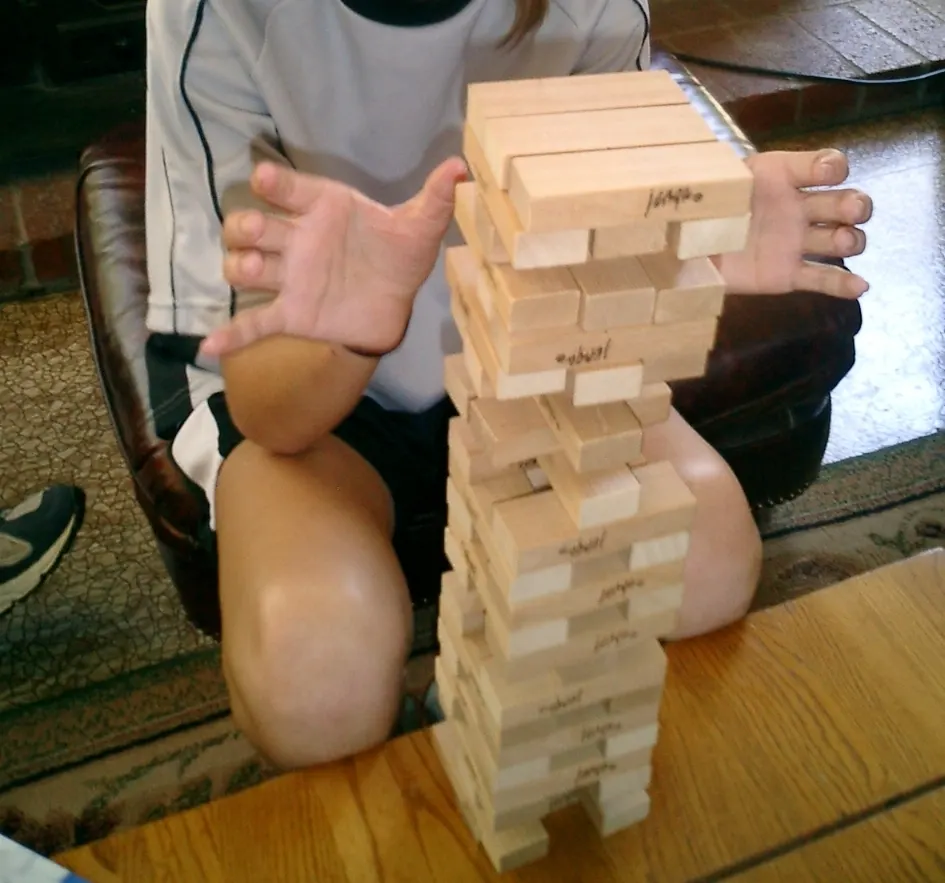
Giant Jenga shows up every summer at wedding receptions, breweries, and anywhere a backyard has grass and adults. The appeal is simple: it is the same mechanic as classic Jenga, scaled up to a 4- to 5-foot tower that falls with a crack you can hear across a cookout. We have been building and buying these since 2008, back when the first drinking Jenga game write-ups started making the rounds, and the market has sorted itself out since. Here is what to buy at $50, $75, and $130, and what to build from a stack of 2x4s if you want it done your way.
What is the best Giant Jenga set to buy?
For most backyards, the GoSports Giant Wooden Toppling Tower. It sits in the middle of the price range, uses real kiln-dried pine instead of mystery import softwood, and stacks past 5 feet when you load it right. The canvas carry case matters more than it sounds like: 54 giant pine blocks weigh about 25 pounds, and nobody wants to haul that in loose armloads.
 GoSports Giant Wooden Toppling Tower. 54 kiln-dried natural pine blocks, 2.5-foot starting height, stacks over 5 feet mid-game, canvas carry case included. The best of the mid-range picks for a real backyard set.
If you want the real thing with Hasbro’s name on the box, step up to the Jenga Giant JS7. If you want to spend as little as possible and still play on a tower taller than a dog, drop to the Giantville. We break both down below.
How do the top Giant Jenga sets compare?
| Set | Blocks | Starting height | Max stacked | Wood | Price |
|---|---|---|---|---|---|
| Giantville Giant Tumble Tower | 56 pine | 2.5 ft | ~4 ft | Pine | $49.92 as of Nov 3, 2026 |
| GoSports Giant Toppling Tower | 54 kiln-dried pine | 2.5 ft | 5+ ft | Pine | $74.99 as of Nov 3, 2026 |
| Jenga GIANT Hardwood (JS7) | 54 hardwood | ~2.5 ft | 5+ ft | Hardwood | $129.95 as of Nov 3, 2026 |
| DIY 2x4 build | 54 blocks | ~2.5 ft | ~4.5 ft | Pine 2x4 | ~$25 in lumber |
Which Giant Jenga is worth the extra money?
The Jenga GIANT Hardwood Blocks (JS7) is the only version that can call itself Jenga on the box. The difference you can feel is the wood: licensed hardwood blocks slide against each other more cleanly than pine, so pulls on the lower rows do not drag three neighbors out with them. It is also the heaviest set at the full height, which lands the tower with a satisfying thud instead of a plasticky clatter.
 Jenga GIANT Hardwood Blocks (JS7). 54 kiln-dried hardwood blocks, officially licensed by Pokonobe Associates, stacks to over 5 feet mid-game, heavy-duty zippered carry bag. The upgrade pick if you want the real licensed set and the smoother pull action hardwood gives you.
Is it worth the extra $55 over the GoSports? If this set is going to live at a brewery, a wedding venue, or a vacation rental that sees it played a hundred times a summer, yes. For a backyard that pulls it out six times a year, the GoSports pine will outlast you.
What is the best cheap Giant Jenga set?
The Giantville Giant Tumble Tower under $50. You get 56 blocks instead of 54, which is a nice detail because the first few collapses will produce at least one splintered corner you want to retire. It will not stack as tall as the licensed set and the wood is less consistent, but it will absolutely get you into the game at the lowest buy-in on the market.
 Giantville Giant Tumble Tower. 56 natural pine blocks, grows past 4 feet, dry-erase scoreboard and marker included, nylon zippered carry bag. Two spare blocks are the quiet reason to prefer this over similarly priced competitors.
How do I build Giant Jenga from 2x4s?
The DIY route is a real option for anyone with a miter saw, a sander, and three hours. The lumber will run you around $25, which is half the Giantville price for a tower you can tune to the exact ratio Jenga uses.
The target block ratio is 3-to-1 length to width. A standard pine 2x4 is actually 1.5 inches by 3.5 inches, which gives you a width of 3.5 inches, so each block cuts to 10.5 inches long. The thickness falls out of the lumber at 1.5 inches, so a stacked row of three blocks sits 3.5 inches wide (one block) by 10.5 inches across (three blocks sideways). That is the Jenga ratio exactly.
Cut list for 54 blocks:
- Six 8-foot pine 2x4s. Each 8-foot board yields nine 10.5-inch cuts plus a short waste piece. Six boards gives you 54 blocks on the nose.
- Pick straight-grain pine with no twist. Sight down each 2x4 at the lumber yard and reject anything that looks banana-shaped.
- Set a stop block on your miter saw at 10.5 inches so every cut is identical. Any length variation over about a 32nd of an inch will make the tower lean on itself before you have five rows up.
After cutting, chamfer every long edge with a block plane, a router with a V-groove bit, or sandpaper. Fresh pine from a mill is sharp enough to cut you, and chamfered edges are also how real Jenga blocks slide so cleanly. Sand each block with 120 grit and then 180 grit on an orbital sander. The faces should feel glass-smooth, not fuzzy, or they will drag against each other on pulls.
Total DIY cost at Home Depot prices right now: about $25 for the 2x4s, $4 for sandpaper, $0 if you already own the saw and sander. Build time: 2 to 3 hours including stop-and-measure fiddling. The resulting tower stacks to 4.5 feet, half a foot shorter than the licensed hardwood but a full three-foot adult torso taller than classic Jenga, which is the whole point.
If you want to go deeper on the DIY cuts, we also like Instructables’ build and DIYPete’s video walkthrough; both show the saw setup and sanding sequence in detail.
Where should I actually set up a Giant Jenga tower?
Three rules that cost nothing to follow and save you blocks:
- Level ground. A patio paver, a plywood sheet, or a very flat lawn. Any tilt kills the tower before you reach a stacked height worth playing on.
- Buffer. Keep a 10-foot ring around the base clear. A collapsing 5-foot tower throws blocks 4 to 6 feet in random directions, which is funny the first time and a trip to the ER the fifth.
- Not on concrete. Collapses on hard surfaces chip corners fast. A flattened cardboard box or an outdoor mat extends block life by seasons.
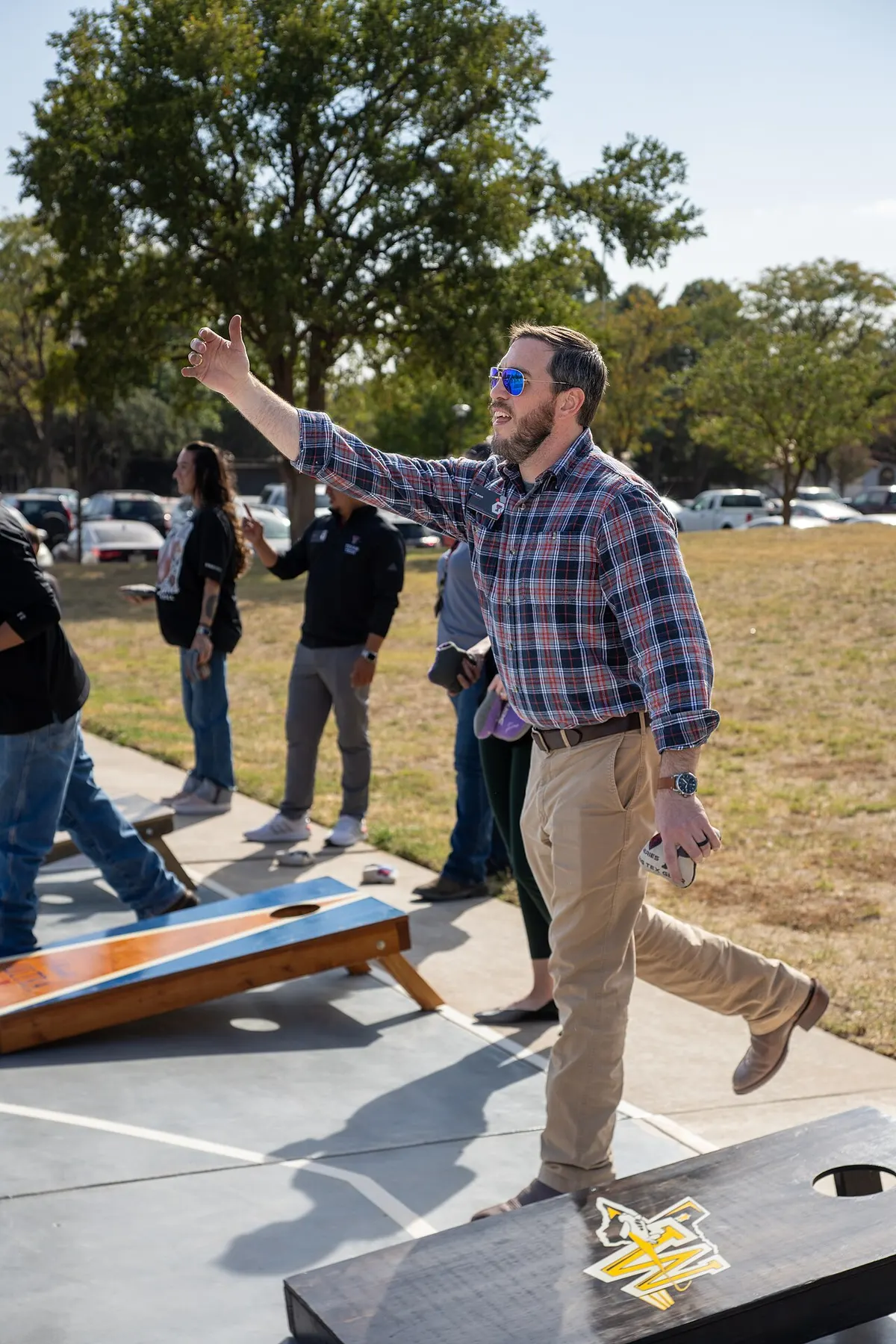
If the yard is already set up for cornhole or ladder golf, park the Jenga tower well away from throw lines. Nothing kills a tower faster than a bag or a bola landing in the wrong zip code.
Can we play Giant Jenga as a drinking game?
Yes, and this is where we talk you out of the version your college roommate wants to run. The classic “write a shot on each block” rule turns a game that already lasts 15 minutes into a trip to the hospital, because the whole point is pulling blocks from a stable tower and that gets harder every turn. Instead:
- Write chores, truths, or dares on about 20 of the 54 blocks and leave the other 34 blank. Pull a marked block, you do the thing. Pull a blank block, you place and pass.
- Drinks sit beside the game on a side table in actual cups, with water in the ones nobody is drinking from. Keep yourself hydrated and keep the game on the game, not in your hand. Save shots for after the tower falls.
- Dares scale with the crowd. A wedding reception crowd gets “tell the story of how you met your plus-one,” not “finish your drink.” Pick the vibe before the first block comes out.
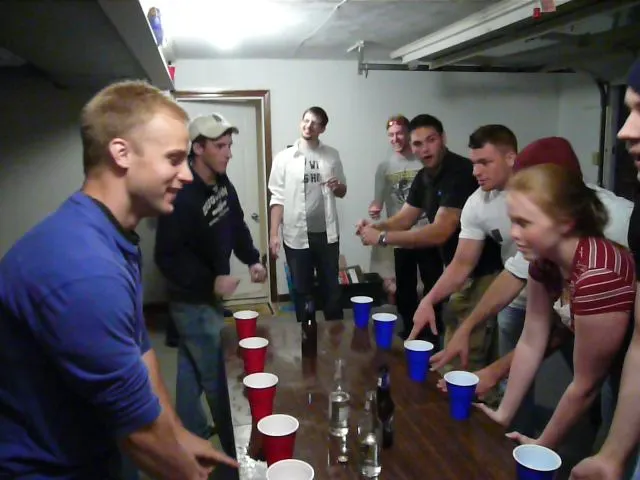
This is still a drinking site, so the moderation note is the same one we have given since 2008: giant tower games are a lot more fun played sober enough to actually pull a block from the middle row at eye level. All content assumes drinkers of legal drinking age. If you want a game built for drinking, flip cup is a better match. Giant Jenga is a backyard skill game that drinks live next to, not inside.
Quick answers
Best Giant Jenga overall for a backyard: GoSports Giant Toppling Tower, 54 kiln-dried pine blocks, stacks past 5 feet, $75 range.
Best licensed set: Jenga GIANT Hardwood (JS7) by Hasbro, hardwood blocks with smoother slide, $130 range.
Best cheap set: Giantville Giant Tumble Tower, 56 pine blocks (two spares), under $50.
DIY cost: about $25 in pine 2x4s for 54 blocks, 2 to 3 hours of cutting and sanding.
Block dimensions: 1.5 inches by 3.5 inches by 10.5 inches, which is the Jenga 3-to-1 length-to-width ratio using standard pine 2x4 stock.
Number of blocks: 54 (same as classic Jenga). Some budget brands ship 56 to 57 so you have spares when corners chip.
Height: licensed hardwood stacks over 5 feet; mid-range pine over 5 feet; budget pine over 4 feet; DIY 2x4 build around 4.5 feet.
Rules: standard Jenga. Pull a block from any row below the highest completed row with one hand, place on top, last to place before the tower falls wins. Giant Jenga uses an identical scoring and turn structure to the classic game.
Setup rule we never skip: level ground, 10-foot buffer around the tower, nobody playing in bare feet within range of a falling 5-foot stack.