We ran our first quarters rules page in 2008, back when a bar table, a shot glass, and a pocket full of coins was the entire equipment list for the night. Seventeen years later the game has not changed. What has changed, and it is an improvement, is how we run it at home: water in the shot glass, water in the personal cups, real drinks on the side, and nobody chugging on a miss. Same physics, same trash talk, no lost weekend.
If you are new to it, quarters is a bounce-shot game. Every player takes turns trying to bank a US quarter off a hard tabletop into a shot glass. Land the shot and you assign a sip. Miss it and the coin passes. That is the whole loop. The variations below are what make it worth playing for more than ten minutes.
What you need to play quarters
The gear list is short and every item is probably already in the house.
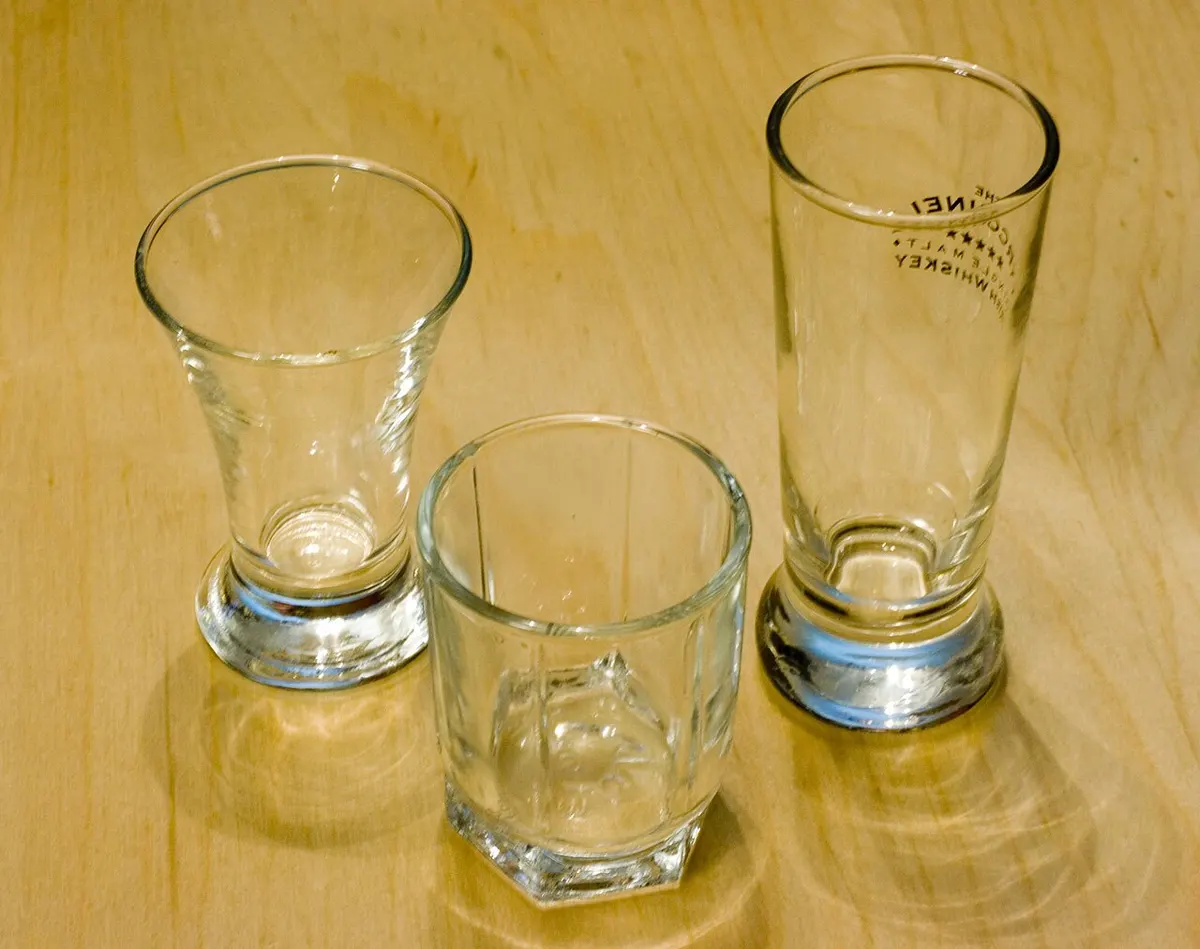
- One shot glass. A standard 1 to 1.5 oz shot glass. Heavy base helps, thin sides help, a wide mouth makes it too easy.
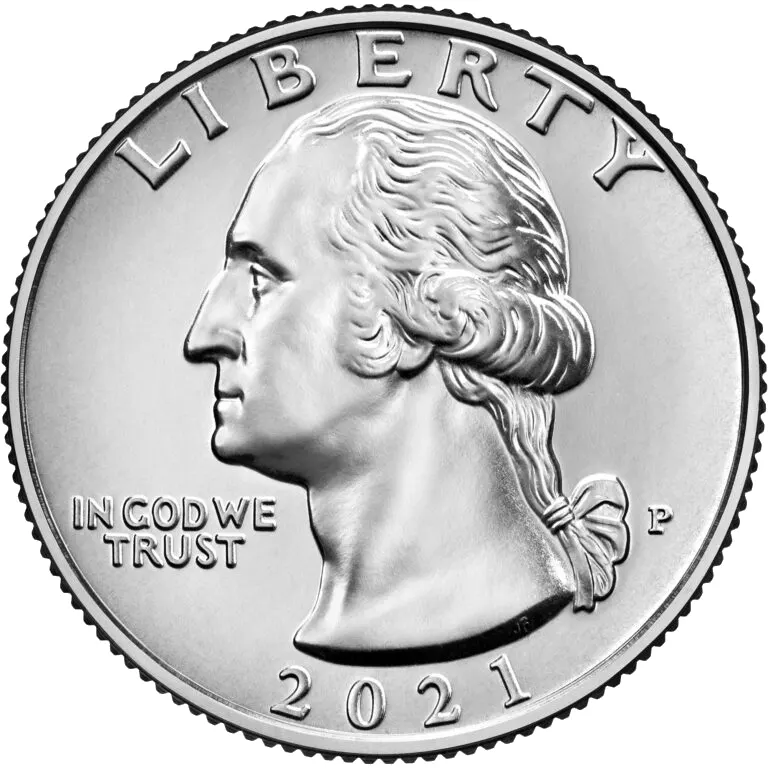
- One quarter. A regular US quarter, minted 1965 or later (the clad ones). Silver-era quarters are lighter and behave differently. Rinse it; it has been in a lot of pockets.
- A hard, flat table. Wood, laminate, or a hard resin folding table. Glass tops crack. Cloth tabletops kill the bounce. If it is scratchable and you care, throw down a bar mat.
- Cups for every player. Rocks glasses, red cups, or coffee mugs. Everyone gets their own, filled with whatever they are drinking. Water on the side for anyone tapping out of a round.
- Water pitcher. Non-negotiable. See the bar note below.
The basic quarters rules
The game runs clockwise around the table. Each player takes one shot per turn, then passes the quarter to the left.
- Set up. Place the empty shot glass in the middle of the table. Fill personal cups.
- The bounce. The shooter pinches the quarter with two fingers and taps it down onto the table so it bounces up and (hopefully) lands in the shot glass. The coin must bounce at least once. A no-bounce throw is a miss and the turn ends.
- A make. If the coin lands in the shot glass, the shooter picks any other player. That player takes a sip. The shooter then shoots again. Consecutive makes let you keep shooting and keep assigning sips.
- A miss. Coin passes clockwise to the next player.
- Chain rule. Three makes in a row earn the shooter the right to set one house rule for the rest of the game (see the house rules section). Rules stack. Rules never override the safety and moderation basics below.
- The reset. Any time the shot glass gets tipped over, whoever tipped it re-centers the glass and loses their next turn. Slow the game down; nobody wants a broken glass.
That is the ninety-percent version. Two smaller rules that come up:
- Rim shots. A quarter that lands on the rim and rocks in counts. A quarter that lands on the rim and rocks out does not.
- Runaway coins. If the coin bounces off the table entirely, retrieve it and pass. The bounce still counted as an attempt.
Popular quarters variations
Straight quarters is good for four or five players. Past that the rotation gets slow and the game turns into a spectator sport. These variations solve for group size, pace, or difficulty.
| Variation | Best group size | Difficulty | Water-cups friendly | The hook |
|---|---|---|---|---|
| Basic quarters | 3 to 5 | Medium | Yes | One shot glass in the middle, take turns |
| Chandeliers | 6 to 10 | Medium | Yes | Center cup ringed by personal cups; center cup means everyone drinks |
| Speed quarters | 4 to 8 | Hard | Yes | Two shot glasses, players race the coin around the table |
| Baseball quarters | 4 or 6 (even) | Medium | Yes | Four glasses at bases; makes are singles through home runs (see below) |
| Ponderosa | 5 to 8 | Medium | Yes | Ring of personal cups plus a center community cup |
| Rule quarters | 4 to 6 | Easy | Yes | Every three-in-a-row make earns the shooter a table rule for the night |
Chandeliers
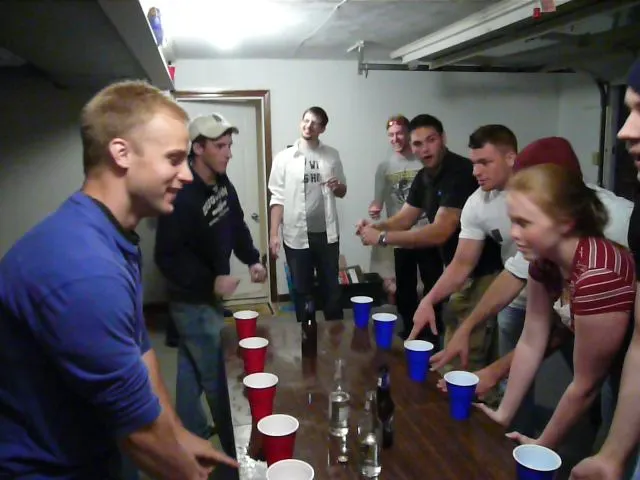
Center shot glass, everyone’s cup ringed around it, rims touching the center. Everyone shoots at once, or players take turns (both are common). Coin in your own cup: you sip. Coin in the center cup: every player sips. It is the best variation for larger groups because every throw has stakes for someone. If you are running water cups, the center cup means everyone takes a sip of water and refills the shot glass.
Speed quarters
Two shot glasses at opposite ends of the table. Two players shoot at the same time. Whoever makes their shot first passes the glass to their left. The player to the left has to make their own shot before the glass on their other side arrives. If both glasses reach the same player, that player owes the table one full sip (or one full water cup) and both glasses reset.
Baseball quarters
Four shot glasses in a diamond, positioned like bases. Each glass is worth a hit: single, double, triple, home run. Players “at bat” get three throws each. A make advances runners. Three misses in one turn is an out. Three outs and the next player is up. Play innings. It scales to two teams and a scoreboard. See our companion legacy write-up for the full baseball drinking game rules; the modern water-cups version is the same game with sips of water on the miss side.
Ponderosa
Every player gets a personal cup. A community cup sits in the middle. Make it in your own cup and only you sip. Make it in the community cup and everyone sips. Miss and you pass. Simple, forgiving, works for six to eight.
Rule quarters
The pure-rules variation. Any player who makes three consecutive shots gets to declare a rule that lasts the rest of the game. Classic ones: no first names, no pointing, no swearing, no left-hand drinks. Violating a rule costs the offender a sip. This is where the game gets funny for a large group and why we like it as an ender.
House rules worth adopting
| Rule | What it does | Verdict |
|---|---|---|
| Water-side, drink-side table | Half the table is water cups, half is drink cups; anyone can swap sides silently | Keep, always |
| Two-hands ban | Coin must be shot with one hand only | Keep |
| Coin-drop retreat | Drop the coin on the pickup and lose a turn | Keep |
| Rim rocker counts | If it lands rocking on the rim and settles in, it counts | Keep |
| Trick shots on a make | Behind-the-back or elbow-drop for a re-shot, called before the throw | Your call |
| Chug the shot on a make | Ends the night in twenty minutes and encourages exactly what we do not want | Skip |
| Everyone drinks on a miss | Same problem, worse | Skip |
The last two are how a lot of college versions play it. They are also why the game gets a reputation for putting people in the hospital. Skip them. The shot glass is the target, not a delivery mechanism.
Safety and moderation basics
Quarters can be played kindly and it can be played stupidly. The kind version:
- Everyone at the table is 21 or over.
- No one is coerced into sips. Water swaps are silent and never negotiated.
- Sips are actual sips. Chugging on a make or a miss is out.
- Any player who has clearly had enough is done. Full stop. Refill their cup with water and keep the game going.
- Someone at the table is not drinking alcohol at all; they hold the keys and make the call on when the game ends.
We have watched this game for seventeen years. The friends who still play it are the ones who kept the sips small. It is a bounce contest first, a drinking game second.
The gear that matters
You can use anything. But two upgrades make quarters better:
Skip the “quarters kit” sets that show up in search. They are usually a novelty shot glass and a laminated rules card, marked up 300 percent over what the parts cost separately.
Common quarters questions
- Can you use a nickel or dime instead of a quarter? Yes, and the game gets easier or harder respectively. Dimes are the hard mode; nickels are the easy mode. Purists use a quarter.
- What if my table has a lip or a raised edge? Play there. The lip actually helps by keeping runaway coins on the table.
- Does the shot glass need to be full? No. Empty is standard. Any liquid in the target glass gets kicked out by the coin anyway.
- What is a fair “three makes in a row” cutoff for setting a rule? Three is standard. Some houses play five for a stronger rule (mandatory nickname for the night, for example). We keep it at three.
The quick answers
- Equipment: 1 shot glass, 1 quarter, 1 hard table, cups for every player, water pitcher
- Bounce required: yes, at least one bounce off the table before entering the glass
- On a make: shooter picks another player to sip, shooter shoots again
- On a miss: coin passes clockwise
- Rule creation: 3 makes in a row lets the shooter set one house rule
- Best variation for 6+: chandeliers or ponderosa
- Modern standard: water cups on the side, sips stay small, no chugging
For the whole party-game set, run our beer pong rules, our flip cup rules, and the cornhole rules for daylight hours. If you are outfitting the drink table, start with the home bar essentials. For the historical record on how quarters and its friends got classified, the Wikipedia entry on quarters has the coin-game family tree.