Someone just showed up with a case of warm beer. You have five minutes before everyone else is here, no cold ones in the fridge, and the clock is ticking.
We have been running this test since 2008, and we still get asked the same question every summer. There is one fastest way to chill a beer, there is a decent backup when you cannot do the fast method, and there is a wrong way that will cost you glass and beer on your kitchen floor. Below is each option with the actual times, the physics in plain English, and the gear we use to pull it off at a backyard party.
A note on moderation: a cold beer is better than a warm one, and that is the only reason to be fast about it. Pace yourself, keep water on the table, and never serve to anyone underage.
What is the fastest way to chill a beer?
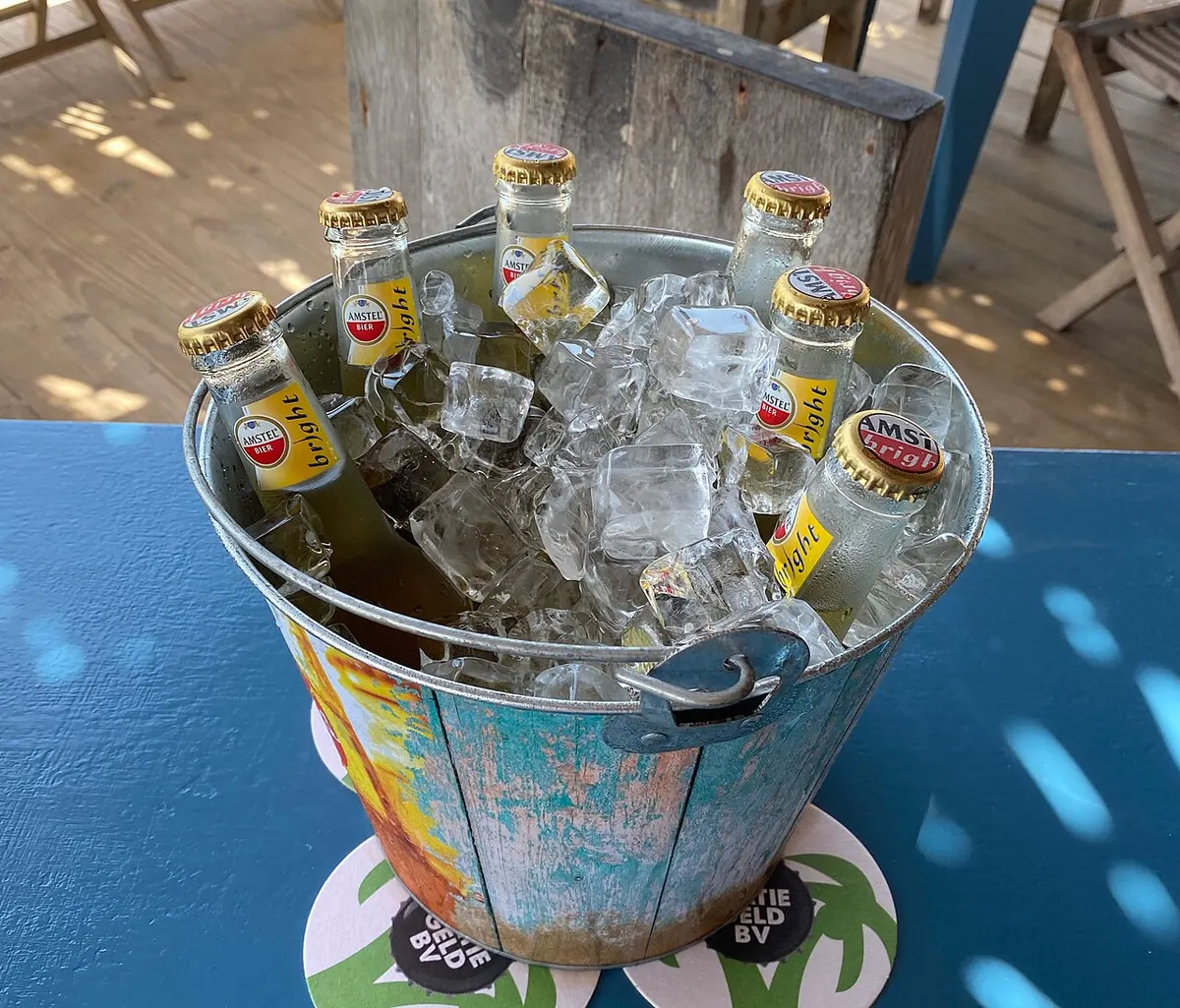
The ice bath with salt wins every time. Fill a bucket, cooler, or pot with ice, add just enough cold water to let the beer actually submerge, stir in two to three tablespoons of plain table salt or rock salt per quart of water, drop the beers in, and spin each one for ten seconds every minute. A 12 oz bottle at room temperature gets to around 38°F in roughly five minutes.
The physics is called freezing point depression. Plain ice water sits at 32°F because that is where water freezes. Salt dissolves into ions that interfere with ice forming, so the slurry can get well below 32°F before it refreezes. That same bath often reads 20 to 24°F on a thermometer. A beer that is normally sitting in 32°F water is now sitting in roughly 22°F water. Heat flows faster across a bigger temperature difference, so the beer loses heat faster. According to a PopSci explainer on the trick, the bath keeps working as long as there is undissolved ice left to keep the temperature pinned down.
Spinning matters because water right next to the glass warms up as it pulls heat out of the beer, and beer right next to the glass cools down as it loses heat. Both of those layers slow the transfer if you leave them in place. A ten-second spin resets both layers back into their larger pools, and the chill picks right back up.
How long does each method take, really?
We ran this on a 72°F kitchen with 72°F bottles, every method timed to drinkable temperature (around 38 to 40°F for a lager, around 45°F for an ale).
| Method | Time to drinkable | Risk of busted beer | Gear needed |
|---|---|---|---|
| Salt + ice + water bath, with spin | 4 to 6 min | None | Cooler or bucket, ice, salt |
| Plain ice water bath, with spin | 10 to 15 min | None | Cooler or bucket, ice |
| Wet paper towel + freezer | 10 to 15 min | Low if you set a timer | Freezer, paper towels |
| Snowbank or snow pile (winter) | 15 to 20 min | None | Snow |
| Plain freezer (no towel) | 30 to 60 min | High if forgotten | Freezer |
| Fridge (shelf) | 2 to 4 hours | None | Fridge |
The salt bath is roughly ten times faster than putting a dry can in the fridge, and about six times faster than the dry freezer. It is also the only method you can scale: a single cooler can handle a case of beer in one shot, as long as there is enough ice and enough water to submerge every bottle.
The wet paper towel trick, with a timer
If you only have one or two beers and no cooler, this is the honest second-best. Wet a paper towel with cold tap water, wring it so it is damp but not dripping, wrap it around the can or bottle, and lay the whole thing on its side in the freezer. In 10 to 15 minutes it is drinkable. In 25 minutes it is slush. In 40 minutes it has shattered.
The reason it works: water conducts heat about 24 times better than still air, and as the water on the towel evaporates it pulls even more heat off the beer. BeerSmith’s writeup measured roughly 2 to 4 times faster than a dry can in the same freezer.
Why the plain freezer is the worst option
Beer in a freezer with no towel, no water, no insulation, is sitting in dead air. Air is a terrible conductor of heat, roughly 25 times worse than water. So a dry can in a freezer loses heat slowly for the first 20 minutes while the surface air cools, and only speeds up once the surface temperature of the can gets close to the air temperature. By then, the beer at the very surface of the can is near freezing, while the center is still warm.
Three things go wrong:
Beer freezes before it chills evenly. The outer layer hits 25°F while the center is still at 50°F.
The beer expands. Beer is mostly water, water expands about 9% when it freezes, and glass bottles cannot stretch.
You forget. Everyone forgets. Someone throws in two cans “for later,” says the magic words “I’ll remember,” and does not.
If this is your only option, use the wet paper towel method above and set a 15-minute timer on your phone. The timer is not optional.
The gear we use
Three picks, each with a specific job. Prices are live from Amazon and timestamped on the card.
 Igloo BMX Hard Cooler (25 to 72 QT). Our daily driver for the ice-salt-water bath. Thick rotomolded walls, blow-molded hinges, and sized so a 50 QT fits a 24-pack plus 20 lb of ice. Good enough that ice-salt slurry stays sub-freezing for an hour after you dump it in.
 RTIC 45 QT Ultra-Tough Hard Cooler. Upgrade pick if you host a lot. Three inches of insulation, holds ice three days in 90°F sun, and the latch system does not break the way the lower-end Igloos sometimes do after a season. Overbuilt for just chilling beer, perfect if the same cooler also goes camping.
 YETI Rambler 64 oz Bottle with Chug Cap. Not for chilling, for keeping chilled. Pour your freshly cold beer into a prechilled Rambler and it stays sub-50°F for about 24 hours. The chug cap means you are not fighting a tiny opening when you pour a round. We use ours as the "backup fridge" at a long cornhole session, after the ice bath has done its job.
 Photo: PattayaPatrol, CC BY-SA 4.0, via Wikimedia Commons
Common mistakes we see at every party
Not enough water in the bath. Ice alone, dry, is useless. The water carries the cold to the beer; ice without water is just a pile of cubes with air gaps. Fill the cooler so the beers are at least halfway submerged.
Too little salt. Two to three tablespoons per quart. If you dump a tiny shake of salt in a 20-gallon cooler, you did nothing. Scale up with the water.
No spinning. A still bath still works, it just takes two to three times as long. A ten-second spin per minute is not optional if you are promising five minutes.
Mixing salt bath with ice you plan to put in a drink. Fish out ice from a separate bag for drinks. Nobody wants a salt rim they did not order.
Opening a bottle before you pat it dry. The salt water hits the bottle rim and you get a weird metallic tang on the first sip. Towel it off, then open.
When the ice bath is not an option
Winter party in the North, no cooler? Pack beers in clean snow on the shaded side of the house, not in a sun pile. Snow is a decent insulator, but the ice crystals on the outside of the pack conduct heat about three times faster than air alone. Beers hit drinkable in about 15 to 20 minutes.
Camping with just a stream? Submerge the beers in moving water with a bag or mesh and tie the bag to a rock. Moving water pulls heat off faster than still water. A 60°F creek chills a beer in about 15 minutes. A still 60°F lake takes 45.
Airplane layover with a six-pack and no fridge? That is a problem to solve another way. The bathroom sink does not count as a chill method.
Quick answers
What is the fastest way to chill a beer? Ice bath with salt and water, spin for 10 seconds a minute, done in about five minutes.
How does salt chill beer faster? Dissolved salt lowers the freezing point of water, so the bath stays well below 32°F and the beer loses heat to the colder bath faster.
Does the wet paper towel in the freezer trick actually work? Yes, 10 to 15 minutes to drinkable, 2 to 4 times faster than a dry can.
How long can a beer stay in the freezer before it explodes? 20 to 30 minutes is usually safe for a 12 oz can or bottle. Past that, ice crystals and expansion crack glass. Set a timer.
Can I chill a beer in a glass of ice water? Yes but it is slower. Add a tablespoon of salt and submerge the bottle. About seven minutes for one beer.
Why does spinning the bottle make it chill faster? It resets the warmed-up water layer on the glass and the cooled-down beer layer on the inside, so heat keeps flowing fast.
Where to go next
If you already have the ice problem solved and the gear picked out, the next question is usually about what else to keep in a decent portable cooler for a party. If you are the host, our home bar essentials list covers the glassware and tools we actually keep on the bar. And if the point is to pre-batch cocktails and chill the whole batch at once, batch cocktails for parties is the move; use the same salt-ice bath to chill the pitcher.
Chill responsibly, pace the pour, and keep water on the table.